Contact me
WANAKA · AI GAME STUDIO
A game studio you can talk to.
Wanaka turns a chat into a playable 3D game — the assets, the world and the logic included. I have been designing it since the team fit around one desk.
Role
Lead Product Designer
Team
Founding member — joined at 3, now 30
Scope
PC studio end to end · companion mobile app
Status
Closed beta · 20K+ signed up
THE PROBLEM
Everyone has a game idea. Almost no one can ship it.
Three walls
Making a game takes three crafts most people never learned. Art — models, rigs, animation. Worldbuilding — a setting that hangs together. Code — turning rules into something playable. Wanaka's bet: let AI carry the crafts, so people only bring the idea.
MY RESPONSIBILITY
I joined at three people, before the product had a shape. Since then the whole PC creator experience has been mine to design — the Studio editor, Character Factory, the landing page, the business model, and a companion phone app that turns photos into game props.
DESIGN 01 · "I CAN'T DRAW"
Character Factory
Assets
Most AI asset tools are built for professionals — Character Factory is built for players. Describe a character, or just photograph one, and a rigged, animated 3D model lands in your scene. Phone and PC stay connected, so inspiration caught in real life walks straight into your game world.
Character Factory · PC studio
Companion app · a photo becomes a game prop
Companion app · polished scenes, built in minutes
DESIGN 02 · "I CAN'T CODE"
The Studio
The editor
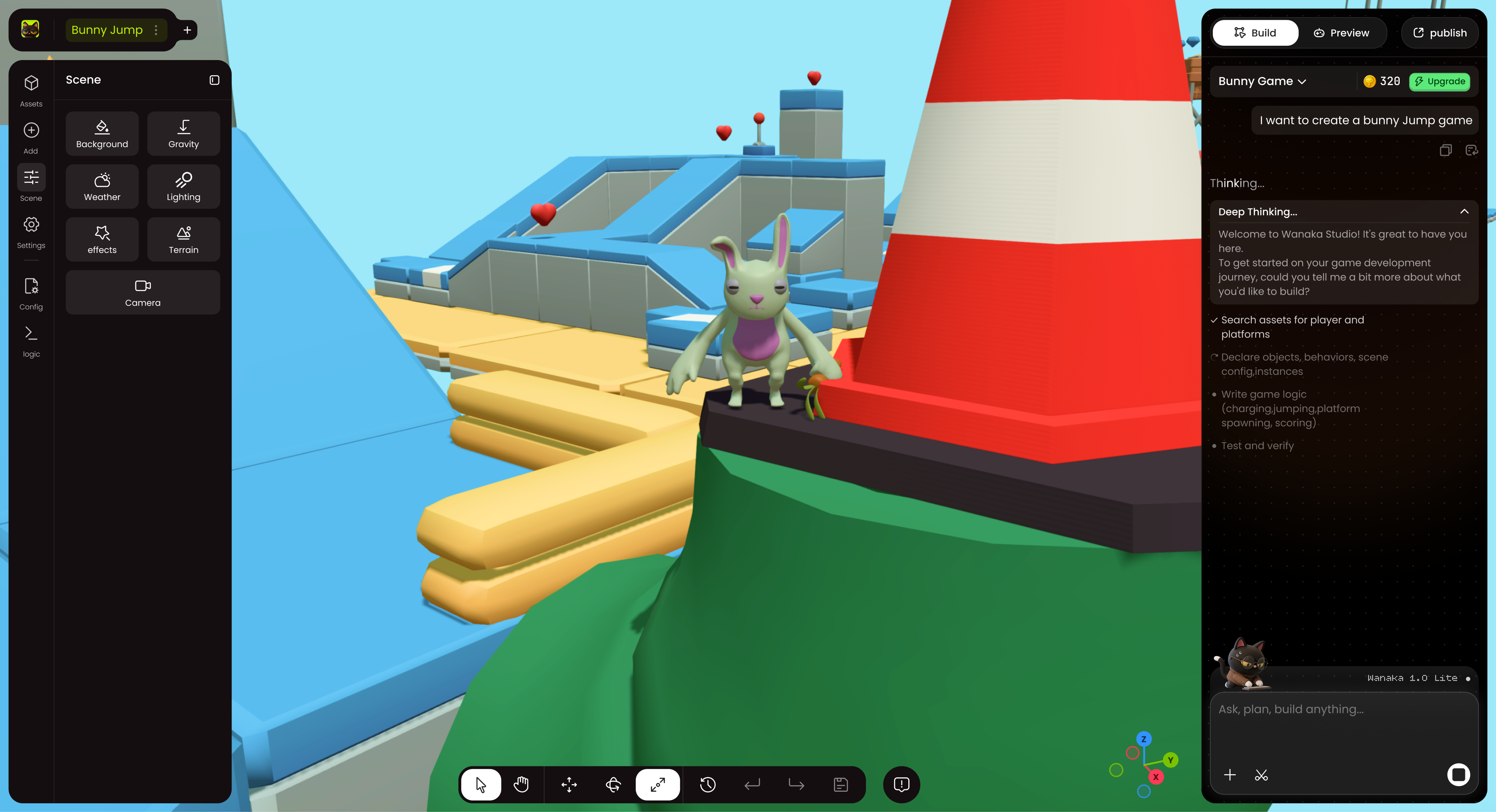
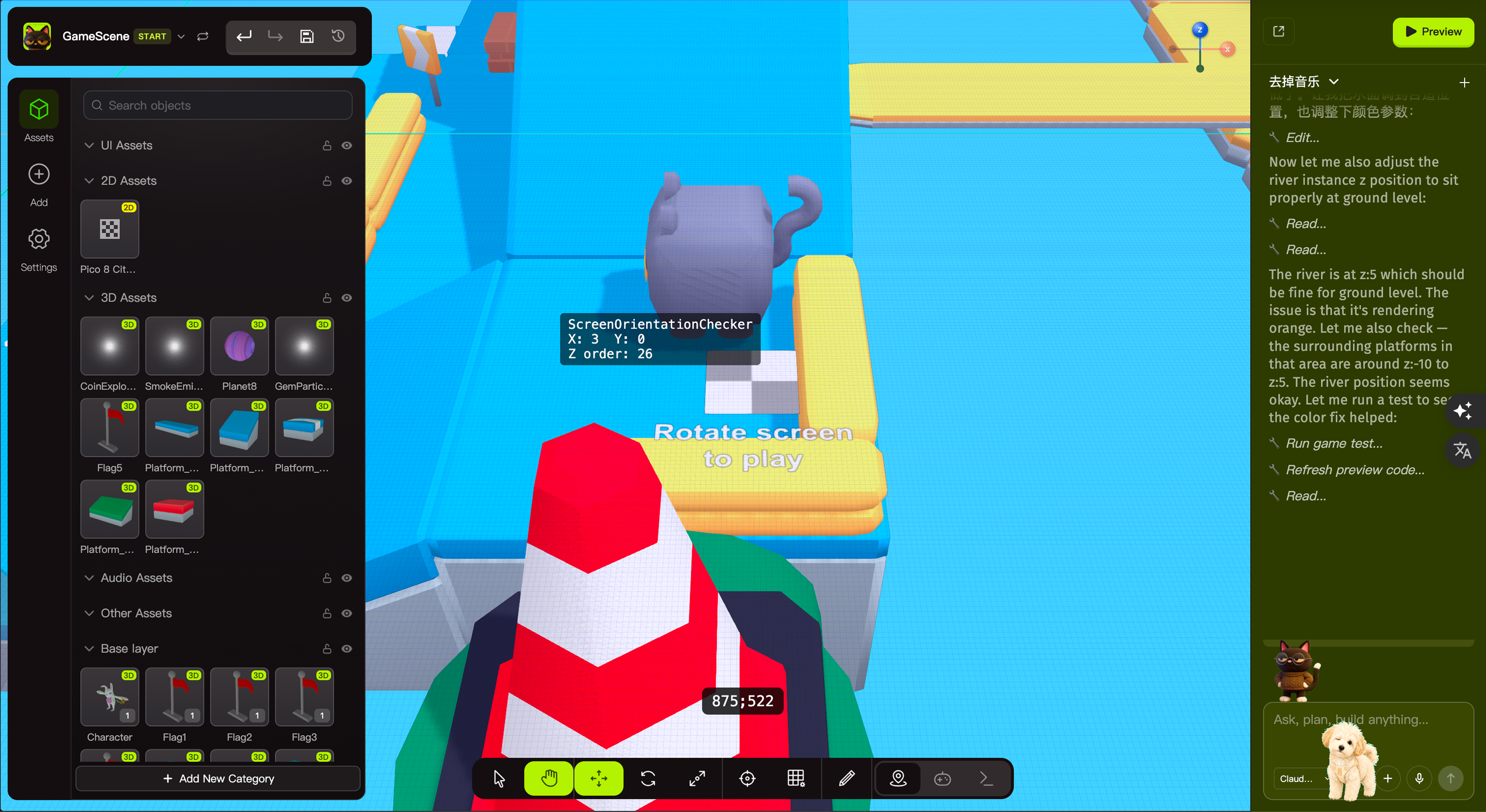
The Studio is where AI orchestrates many models into one coherent world. I designed it for people who have never touched a game engine: building a world feels like playing with blocks — as familiar as Canva or slides. The moment real logic is needed, you hand it to the AI agents on the right. Creators keep the joy of building, and AI absorbs the complexity.
DESIGN 03 · "WORLDS ARE COMPLICATED"
Your game building team
The producer
Game design is the deepest wall: what to build, in what order, and why. So this agent is planned as a game producer — it runs the project with you, from idea to playable, backed by a whole game building team of agents handling levels, systems and pacing. Still in planning today; the flow below is a working demo I built with Claude Code.
AI WORKFLOW
Work as an AI-native designer.
The workflow
Wanaka is an AI-native team building an AI-native product — so my design workflow is AI-native too. AI is the default medium in every step below, and the team reviews live demos.
01
Explore
Directions, variants and edge cases are explored with AI before Figma even opens.
02
Produce
Marketing shots, icons and 3D references are generated, then art-directed by hand.
03
Ship real demos
Flows are rebuilt as working code and pushed to GitHub — the team clicks a link instead of imagining a prototype.
04
Decide
Product direction is sparred with AI first — fast, tireless, and unafraid to disagree — then brought to the team.
Taste, packaged — skills for the team
Using AI is table stakes. The real work is packaging my judgment into written specs — rules, references, QA — that teammates or the pipeline run without me. I've built a stack of these and they're all in daily use: some generate visuals, some define our agents, some speed up how design and engineering ship together. Three examples:


The onboarding and landing demos linked across this site were shipped exactly this way.
STATUS
20,000 signed up — before the doors even opened.
Where it stands
Wanaka is still in closed beta — and more than 20,000 creators have already registered to get in. Launch metrics will land here when the gates open; the demand already speaks for itself.
20,000+
creators registered — during closed beta
3 → 30
team size since I joined
1 yr
from first prototype to a working studio